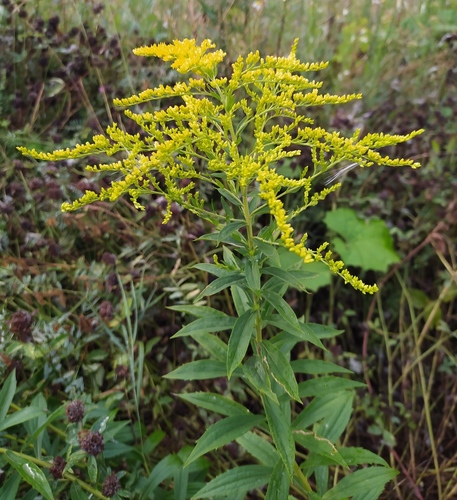
When August arrives and open fields suddenly turn solid yellow as far as you can see, you are looking at Canada Goldenrod (Solidago canadensis). It is one of the most abundant native wildflowers in the eastern and central US, and one of the busiest food sources for late-summer insects.
What it looks like
Canada Goldenrod grows 1 to 1.5 meters tall on slim straight stems, often in dense colonies of thousands of plants. The leaves are long, narrow, and lance-shaped, arranged spirally up the stem. The flowers form an arching plume at the top, made of hundreds of tiny golden-yellow flowers that point outward and slightly downward. Each plume looks a bit like a one-sided fireworks burst. The whole plant has a slightly rough texture when you run your hand up the stem.
When and where
- Season: Flowers from late July through early October.
- Habitat: Old fields, roadside edges, power line cuts, meadow restorations, abandoned lots.
- Best time: Warm sunny mornings, when bees and butterflies are most active.
The pollinator buffet, and a falsely accused plant
A single goldenrod field can support over 100 species of pollinators in a season, including native bumble bees, soldier beetles, and migrating Monarch butterflies fueling up for Mexico. Goldenrod often gets blamed for hay fever, but its pollen is heavy and sticky and barely travels in air. The real culprit is ragweed, which blooms at the same time with tiny green flowers no one notices. Once you teach a child that difference, they feel like they cracked a real mystery.
Spot one this weekend
Canada Goldenrod is Common in almost every open landscape east of the Rockies in late summer. Walk to any meadow or unmowed field edge in August and look for a knee-to-waist-high yellow wave. Stand still next to a flowering plume for one minute and count how many different insects land on it.