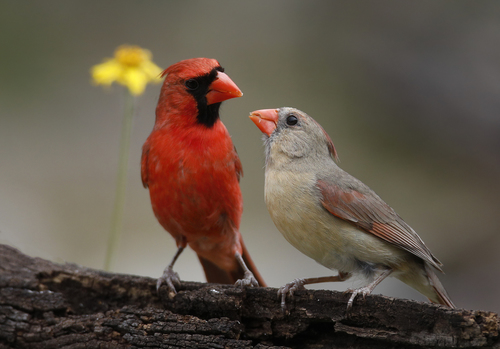
If a fire-engine red bird with a pointy crest lands on your fence and looks straight at you, you just met a male Northern Cardinal (Cardinalis cardinalis). They are the state bird of seven US states for a reason, and they almost never leave their territory once they pick one.
What it looks like
Adults are about 22cm long with a tall pointed crest and a heavy orange-red beak. Males are an unbroken bright red across the body with a small black mask around the bill. Females are a warm tan with red highlights on the crest, wings, and tail. Both have the same chunky triangular beak built for cracking seeds, and both sing, which is unusual because in most songbird species only the males sing.
When and where
- Season: Year round. They do not migrate, so you can see the same pair in your yard every month.
- Habitat: Suburban backyards, woodland edges, parks, dense shrubs, and tangled brush. They love thick cover within a short flight of an open feeder.
- Best time: Early morning at a feeder, or late afternoon when males perch on top of a shrub to sing.
They mate for life
Cardinal pairs stay together year round and often for many years. In late winter you might see a male feeding a sunflower seed beak-to-beak to a female. That is a courtship ritual called mate feeding, and it usually means a nest is coming in the next few weeks. The female does most of the nest building, weaving twigs and grass into a tight cup low in a shrub, while the male brings her food.
Spot one this weekend
Northern cardinals are Common across the eastern US, the Midwest, and the southwest. The simplest way to see one is to put black-oil sunflower seed in a tray feeder near a dense bush. They prefer to land on a branch, look around, then drop to the feeder. Once they trust the spot, they come back every morning at almost the same time.