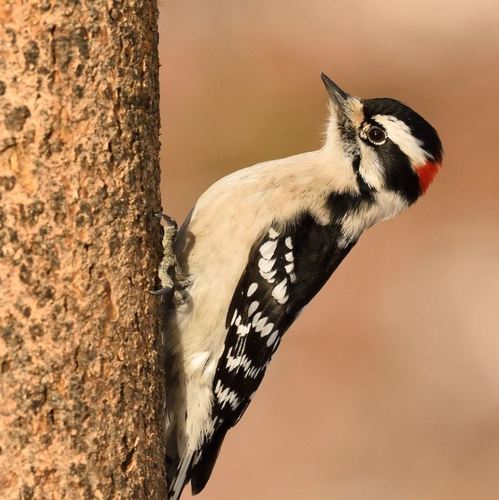
A small black and white bird tapping on a tree branch in your backyard is almost certainly a Downy Woodpecker (Dryobates pubescens). They are the smallest woodpeckers in North America and one of the most familiar birds at feeders.
What it looks like
About 16 cm long, roughly sparrow-sized. The back is black with a wide white stripe down the middle and white spots on the wings. The belly is clean white. Males have a small red patch at the back of the head; females do not. The bill is short, only about a third the length of the head, which is the key field mark separating them from the look-alike Hairy Woodpecker. The outer tail feathers are white with black spots.
When and where
- Season: Year-round resident across most of North America.
- Habitat: Deciduous woods, suburban yards, parks, riverside willows. Anywhere with trees.
- Best time: Early morning to mid-afternoon, especially at suet feeders in winter.
Tiny enough for goldenrod
Because Downies are so small, they can forage where bigger woodpeckers cannot. In late summer and fall, they hammer at goldenrod stems looking for gall fly larvae curled up inside. The bird taps along the stem, listens for a hollow spot, then pries open the gall and pulls out the grub. Watch a weedy field edge in October and you might see one balancing on a stem half its weight, hammering away like a doll-sized lumberjack.
Spot one this weekend
Downy Woodpeckers are Common. Hang a suet feeder for a week and you will almost certainly meet one. In the wild, listen for soft tapping in the lower branches of any tree. Smaller bill plus shorter body means Downy; longer bill plus bigger body means Hairy. Comparing the two side by side at a feeder is one of the best beginner birding wins.