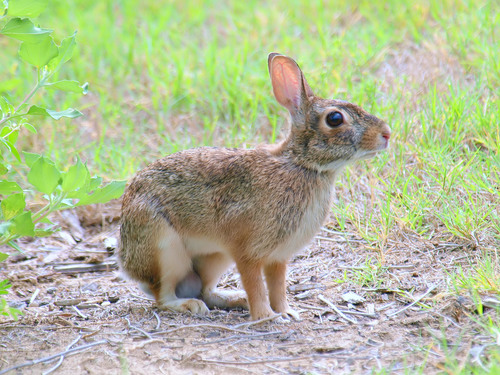
If you walk out at dusk and a brown rabbit freezes on the lawn before zigzagging into the bushes, that is an Eastern Cottontail (Sylvilagus floridanus). The white puff of a tail flashing behind them is the most reliable field mark.
What it looks like
Body length about 40 cm, weight 1 to 1.5 kg, roughly the size of a small house cat. Fur is grayish-brown on the back, white on the belly. The signature feature is the tail, which is brown on top and bright cotton-white underneath, flashing visibly when they hop. Ears are long, about 6 cm, and stand straight up when alert. A small white spot often appears on the forehead between the eyes.
When and where
- Season: Year-round across most of the eastern and central US, into southern Canada.
- Habitat: Suburban lawns, brushy field edges, hedgerows, community gardens, woodland clearings.
- Best time: Dawn and dusk. They feed in the open low-light hours and rest in cover at midday.
The freeze-then-explode trick
When a Cottontail spots a predator (or a curious kid), the first move is to freeze in place. Their fur blends so well with leaf litter that staying still often wins. If the threat keeps coming, they explode into a zigzag sprint, reaching 30 km/h in short bursts and changing direction sharply to confuse the chaser. Mothers nest in shallow grass-lined depressions called forms, not burrows, and visit the babies only twice a day so their own scent does not attract predators. If you find a nest of fuzzy bunnies in your yard, leave them alone. Mom is nearby.
Spot one this weekend
Eastern Cottontails are Common. Step outside at dusk and scan the edge between mowed lawn and any brushy area. A still brown shape that becomes a flash of white tail is your bunny. Walking slowly and stopping often works better than chasing. They will let you get within five meters if you move like another browsing animal.