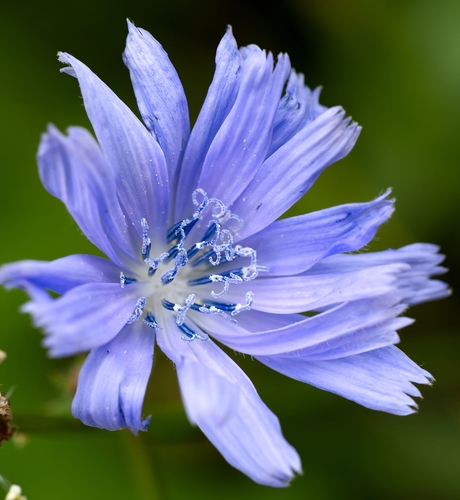
If you spot a wiry roadside plant with bright sky-blue flowers in the morning that seems to vanish by lunchtime, that is Common Chicory (Cichorium intybus). The color is one of the truest blues in North American wildflowers and worth slowing the car for.
What it looks like
The plant grows 60 to 150 cm tall on a tough, almost leafless stem that branches stiffly. Flowers are 3 to 4 cm across, sky-blue, with squared-off petal tips that look like they were trimmed with pinking shears. Each flower is actually a cluster of ray florets, not separate petals. Basal leaves form a low rosette that looks just like a dandelion, but the stem leaves up high are small and clasping. The taproot is long, thick, and white inside.
When and where
- Season: Blooms June through October across most of the US and southern Canada.
- Habitat: Roadsides, vacant lots, dry meadows, gravel parking lot edges. Full sun and poor soil.
- Best time: 7 to 11 am. After noon most flowers close until the next morning.
A roasted root in your cup
Chicory roots have been dried, roasted, and ground as a coffee substitute or extender for at least three hundred years. New Orleans coffee with chicory is the most famous version, born when coffee shortages during the American Civil War forced cafes to stretch their beans. The flavor is nutty, slightly bitter, and caffeine-free. The leaves of a cultivated cousin become Belgian endive, grown in the dark to stay pale and tender. So one plant gives us both a morning beverage and a winter salad.
Spot one this weekend
Common Chicory is Common. Look at any sunny roadside in July before noon. The blue stands out against dust and asphalt at thirty meters. If you go back at 2 pm and the flowers are gone, you have the right plant. Try the same spot two days in a row to confirm the close-by-noon habit, a small thrill for kids learning how flowers respond to the sun.