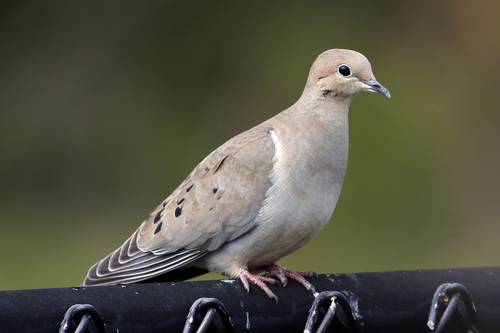
If you hear a slow, breathy "coo, coo, coo" from a power line at dawn, you are listening to a Mourning Dove (Zenaida macroura). They are one of the most abundant native birds in North America, with a population estimated near 350 million.
What it looks like
Mourning doves are about 30cm long, slim, and pale sandy brown all over. The body is plain except for a few scattered black spots on the folded wing and a small iridescent patch on the side of the neck that catches light in pink and green. The tail is long and pointed with bright white edges that flash open in flight. Males show slightly more pink on the chest and a bluer crown.
When and where
- Season: Year round across most of the US, migratory in the far north.
- Habitat: Open woods, suburban yards, farmland, roadside wires, almost any open ground with a feeder nearby.
- Best time: Early morning at ground feeders, where they walk in pairs and eat fallen seed.
The whistling wings
The first thing many people notice about a mourning dove is not the call but the sound it makes taking off. A startled bird produces a sharp whistling whir from its wings, which functions as an alarm call for the rest of the flock. The feathers themselves create the sound, not the voice. The cooing call that gave the bird its name actually belongs only to males advertising for a mate.
Spot one this weekend
Mourning doves are Common across all 50 US states. Sprinkle white millet or cracked corn on the ground under a feeder. Within minutes a pair often walks in. They prefer ground feeding to perches, so a flat platform feeder works better than a hanging one.