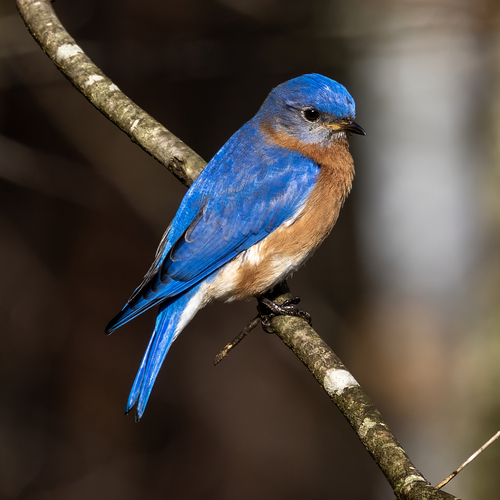
If a stocky bird with a vivid blue back and a warm orange chest is perched on a fence post in an open meadow, you just saw an Eastern Bluebird (Sialia sialis). They look almost too colorful to be real, and they have one of the most loyal fan bases of any North American bird thanks to a 1970s conservation campaign that brought them back from steep decline.
What it looks like
Adults are about 18cm long, a bit smaller than a robin but rounder. Males have a deep royal blue head, back, wings, and tail, with a rich rusty orange throat and chest that fades to white on the belly. Females are paler, with gray-blue backs and a duller orange wash on the chest. Both sit upright on perches and often hunch their shoulders forward.
When and where
- Season: Spring through fall in most of the US, year round in the south.
- Habitat: Open meadows with scattered trees, golf course edges, cemeteries, country roads with fence posts.
- Best time: Mid morning when they hunt insects from low perches in open fields.
They needed our help
In the mid 1900s eastern bluebird populations dropped by an estimated 90 percent because non-native house sparrows and starlings took over the tree cavities bluebirds needed for nesting. Volunteers across North America built and put up millions of wooden nest boxes, sized with a 1.5 inch entry hole that bluebirds can fit through but starlings cannot. The population recovered, and most bluebirds you see today nest in human-made boxes. It is one of the best comeback stories in modern bird conservation.
Spot one this weekend
Eastern bluebirds are Uncommon in suburban areas but Common along rural roads and in parks with nest box programs. Drive or walk past open fields with fence posts and scan the tops of the posts. They sit very upright and the blue catches the sun from a long way off. State parks and Audubon sanctuaries with nest box trails are nearly guaranteed sightings in spring.