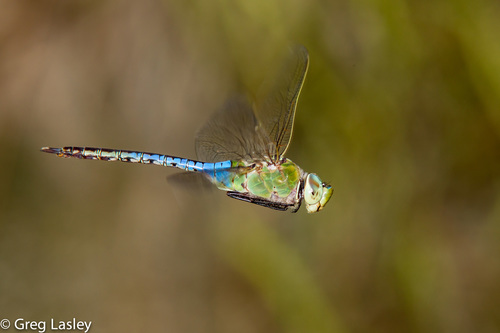
If a big dragonfly with a brilliant green head and chest is hovering over a pond and patrolling the same patch of air over and over, you just saw a Common Green Darner (Anax junius). It is one of the largest dragonflies in North America and one of only a few insects on the continent that migrates long distances.
What it looks like
Adults are 7 to 8cm long with a wingspan of nearly 11cm, big enough to fill the palm of your hand. The thorax (the middle body section) is solid bright green, almost lime colored, with no stripes. The long abdomen is sky blue in adult males and dull purple or olive in females and young males. The wings are clear with a faint amber tint, and a small bull's-eye spot sits on top of the face just behind the giant compound eyes.
When and where
- Season: April through October across most of the US.
- Habitat: Ponds, slow streams, marshes, suburban lakes, even temporary puddles in spring.
- Best time: Warm sunny afternoons when males hover and patrol the open water.
A two-generation migration
Common Green Darners are one of the very few insects that actually migrate north and south like songbirds. A generation that hatches in the southern US in early spring flies north and breeds in the upper Midwest and Canada. The next generation, born in late summer, flies back south to spend the winter as adults. Scientists tracked the migration by attaching tiny radio transmitters and found single dragonflies traveling more than 100 km in a day. Nobody knows yet how they navigate.
Spot one this weekend
Common Green Darners are Common at any pond from spring through fall. Stand still at the edge of the water and scan over the open middle of the pond. Males set up territories and patrol the same lane in slow figures of eight, so once you spot one, you can predict where it will be in five seconds. The green body lights up like a tiny aircraft when sun hits it from the side.