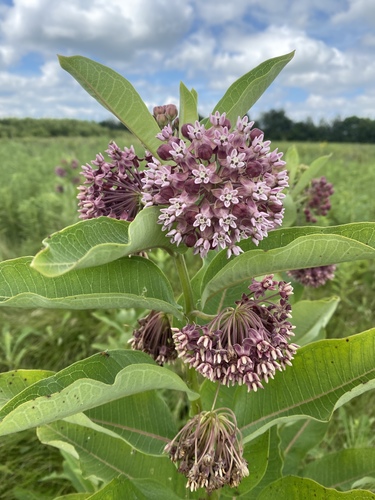
If you walk past a sunny roadside in late spring and see a chest-high plant with pale pink dome-shaped flower clusters, you have found Common Milkweed (Asclepias syriaca). It is the single most important plant for monarch butterfly survival because monarch caterpillars eat nothing else.
What it looks like
Mature plants stand 1 to 1.5 meters tall with thick stems and broad oval leaves arranged in pairs. The leaves are gray-green with a prominent pale midvein and feel almost rubbery to touch. From June through July the plant produces 2 to 5 ball-shaped flower clusters, each made of dozens of small pink-purple flowers. By late summer the flowers turn into long warty seed pods filled with brown seeds attached to silky white floss.
When and where
- Season: Leaves emerge in May, flowers June through July, seed pods August through September.
- Habitat: Roadside edges, abandoned fields, prairie remnants, ditches, and any sunny spot with disturbed soil. Hates shade and competition.
- Best time: Late morning when monarchs and bees are most active on the flowers.
The white sap is on purpose
If you snap a milkweed leaf or stem, a thick white sap leaks out. That sap contains cardiac glycosides, a toxic compound that most insects and animals avoid. Monarch caterpillars are one of the few species that can eat the leaves without getting sick because they store the toxin in their bodies, which makes the caterpillar and the adult butterfly poisonous to most predators. That is why monarchs do not need to hide.
Spot one this weekend
Common milkweed is Common across the eastern half of the US and southern Canada. Look along untreated roadsides, fence lines, and the edges of farm fields. If you spot a yellow-and-black-striped caterpillar on the underside of a leaf, that is a monarch in progress, and the plant is doing exactly what it evolved to do.