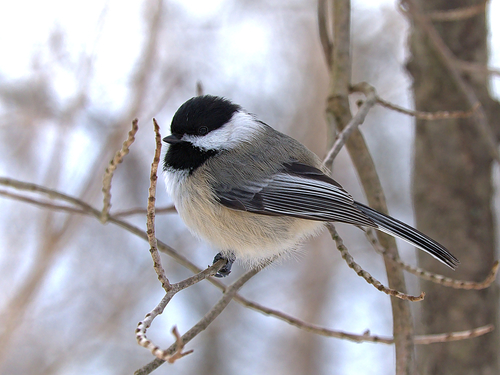
If a tiny round bird with a black cap and bright white cheeks zips up to your feeder, grabs one seed, and zips back to a branch, you just met a Black-capped Chickadee (Poecile atricapillus). They are the friendliest songbird in the northern half of the continent and one of the only wild birds that will land on a human hand for sunflower seeds.
What it looks like
Adults are about 13cm long with a black cap that pulls down to the eyes, crisp white cheeks, a small black bib, and a soft gray back. The belly is buff-colored and the wings show pale edges on each feather. Males and females look the same, so you usually cannot tell them apart in the yard.
When and where
- Season: Year round across the northern US and most of Canada. They do not migrate.
- Habitat: Mixed woods, suburban yards, parks, anywhere with trees and a feeder. They love brushy edges.
- Best time: All day in winter. A backyard tray of black-oil sunflower seed brings them within an hour in cold weather.
They name every threat
The "chick-a-dee-dee-dee" call is not just a name, it is an alarm system. Researchers found that chickadees add more "dee" notes for more dangerous predators. A big slow owl gets two or three dees, a small fast hawk that can actually catch a chickadee gets ten or more. Other birds in the area listen and respond to the same code, so a single chickadee can warn a whole forest.
Spot one this weekend
Black-capped chickadees are Common across the northern US and Canada. Hang a feeder with black-oil sunflower seed near a tree and you will usually have a pair within days. Stand very still with a few seeds in an open palm and after a week of them seeing the feeder, one might just land on your hand.