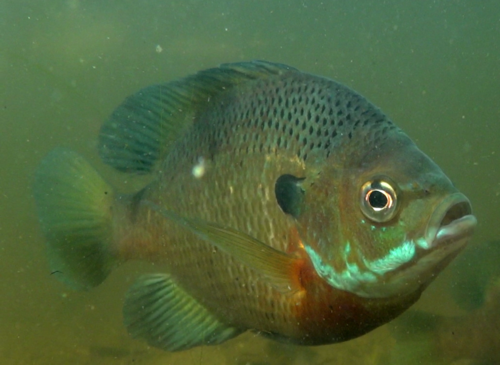
If a kid hooks a small flat fish with a bright orange belly and a dark blue earflap, you have a Bluegill (Lepomis macrochirus) on the line. They are the most caught freshwater fish in North America and almost always the first fish a child ever lands.
What it looks like
Adults are usually 15 to 25cm long and shaped like a flat oval, deeper top to bottom than they are long. The back and sides are olive-green to bluish with darker vertical bars on the flanks. The throat and chest are bright orange to yellow, especially on breeding males. The most reliable field mark is the solid dark blue or black flap at the back edge of the gill cover, which is where the name comes from.
When and where
- Season: Active year round but most easily caught from May to September.
- Habitat: Ponds, slow rivers, lake edges, marina docks. They love spots with weed beds and undercut banks.
- Best time: Early morning and late evening in summer. Around docks they bite all day.
Nest builders in colonies
In spring, male bluegills do something most fish do not. They use the tail to sweep a clean round bowl in the gravel, often right next to dozens of other males all building their own bowls. From above the lake bottom looks like a honeycomb of dinner-plate nests. The males then defend the bowls fiercely, chasing off anything that comes close, even a finger dipped into the water on a dock.
Spot one this weekend
Bluegills are Common in nearly every pond and lake across the US and southern Canada. A simple bobber with a tiny piece of worm or even a kernel of corn under a bridge or dock will catch one within minutes. Hold it carefully, the sharp dorsal spines can poke a small palm, then let it slip back into the water to swim straight down to its nest.