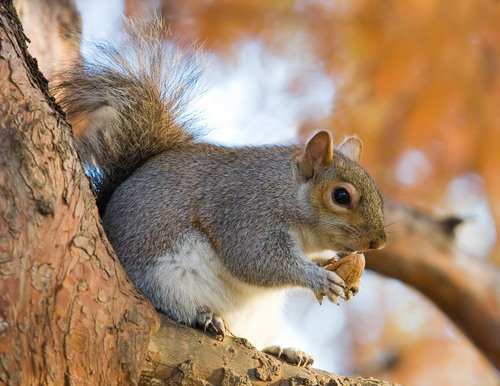
If a soft-gray squirrel with a giant fluffy tail freezes halfway down a tree trunk and stares right at you, you just met an Eastern Gray Squirrel (Sciurus carolinensis). They are the most common mammal in every city park east of the Mississippi and the first wildlife most American kids ever try to feed.
What it looks like
Adults are about 25cm long with a tail almost as long again. Fur is silvery-gray on the back, sometimes with a hint of brown, and clean white on the belly. The tail is broad, bushy, and edged with silver-tipped hairs that catch the light. Some city populations include all-black squirrels, which are just a color variant of the same species and very common in parts of New York, Toronto, and the Midwest.
When and where
- Season: Year round. They do not hibernate.
- Habitat: City parks, suburban yards, woodlots, college campuses, any place with oaks or hickories.
- Best time: Early morning and late afternoon. They are very active right after dawn in fall when burying nuts.
They fake-bury to fool watchers
Gray squirrels are famously paranoid about thieves. If a squirrel senses another squirrel or a crow watching while it tries to bury an acorn, it will dig a hole, pretend to drop the nut, cover the hole, then run off with the nut still in its mouth to a different spot. Researchers at Wilkes University filmed this happening about 20 percent of the time. The squirrels were not just guessing about being watched, they made fewer fake burials when alone.
Spot one this weekend
Eastern gray squirrels are Common in every park, campus, and suburb across the eastern US and southern Canada. Sit on a bench with a few peanuts in the shell and you will usually have a curious squirrel within a few minutes. Watch how they hold each nut with both front paws and rotate it before deciding whether to eat it now or bury it.