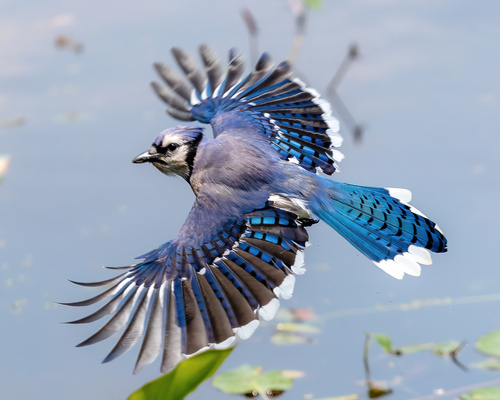
If something brilliant blue and noisy lands on your feeder and scatters every other bird, you just met a Blue Jay (Cyanocitta cristata). They are one of the most recognizable birds in the eastern US: bright cobalt above, clean white below, with a black collar that runs across the throat like a necklace.
What it looks like
Blue jays are about 28cm long with a pointed crest they raise when excited or alarmed. The back, wings, and tail are vivid blue, marked with black bars and white patches that flash in flight. The face is pale gray with a thin black mask. Males and females look identical, though males average slightly larger. The blue color is not pigment, it is structural, which is why a wet or backlit blue jay can look almost gray.
When and where
- Season: Year round across the eastern and central US, southern Canada, and increasingly the Pacific Northwest.
- Habitat: Backyards with oaks, suburban parks, mixed woods, and feeders stocked with peanuts or sunflower seeds.
- Best time: Mid morning, especially in fall when they cache acorns for winter.
A hawk impersonator
Blue jays mimic Red-shouldered and Red-tailed Hawk calls so accurately that even birders get fooled. The theory is that the fake hawk scream clears the feeder for them, or warns other jays of a real predator nearby. They also remember individual humans, plan ahead by caching thousands of acorns each fall, and are credited with helping oak forests spread north after the last ice age.
Spot one this weekend
Blue jays are Common anywhere east of the Rockies. Put out whole peanuts in the shell and step back. Within a day a jay usually finds them, carries one off, and returns for more. Listen for the loud "jay jay" call, then look for a flash of blue moving through the canopy.