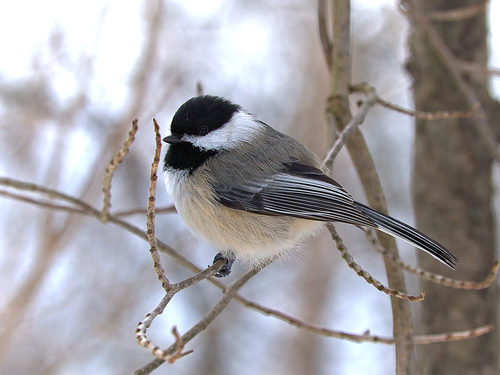
If a tiny gray-and-white bird with a sharp black cap lands two feet from you and yells "chickadee-dee-dee" right at your face, you just met a Black-capped Chickadee (Poecile atricapillus). They are one of the boldest backyard birds in the northern US and southern Canada, and they will land on a hand holding sunflower seeds within a few days of patient feeding.
What it looks like
Chickadees are about 13cm long with a fluffy round body and a head that looks two sizes too big. The black cap runs from the bill to the back of the neck, and a matching black bib covers the throat. The cheeks between cap and bib are bright white. Wings are gray with white edges, and the belly is pale buff. There is almost no visible difference between males and females.
When and where
- Season: Year round. They survive northern winters by lowering their body temperature at night to save energy.
- Habitat: Mixed and deciduous forests, suburban yards, park edges, and almost any feeder with sunflower seeds.
- Best time: Morning at a feeder, especially right after a snowfall when they need to refuel.
The name is a warning
The "chickadee-dee-dee" call is not just a song, it is a predator alert. Researchers found that the number of "dee" notes at the end tells other chickadees how dangerous the predator is. A small fast hawk gets five or six "dees", while a big slow owl might only get two. Nearby birds of other species, like nuthatches and titmice, listen in and react accordingly.
Spot one this weekend
Black-capped chickadees are Common across the northern US and most of Canada. Hang a small mesh feeder of black-oil sunflower seeds near a tree. Within an hour a chickadee will usually find it, grab one seed at a time, and fly back to a nearby branch to crack it open while holding it with its feet.