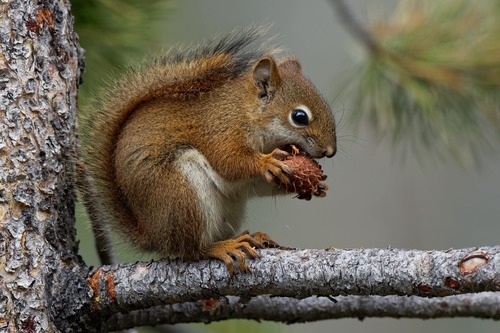
If a small reddish squirrel sits on a low branch and screams a rapid chattering rattle at you for two minutes straight, you just met an American Red Squirrel (Tamiasciurus hudsonicus). They are smaller than gray squirrels, much louder, and they own every conifer they sit in.
What it looks like
Adults are about 20cm long with another 15cm of bushy tail. The upper body is rusty red to reddish brown with a clear white belly, and there is a noticeable black stripe along the side that separates the two colors during summer. In winter they grow ear tufts that look like small horns. Their eyes are large with a pale ring of fur around them that gives them a wide-awake, slightly angry expression.
When and where
- Season: Year round. They do not hibernate. In winter they tunnel through snow to reach food cached underground.
- Habitat: Spruce, pine, and fir forests, mixed northern woods, suburban yards bordering conifers. Rare in pure hardwood forests.
- Best time: Early morning, or any moment something walks under their tree. They will announce your presence immediately.
They build food middens
Red squirrels do not bury seeds one by one like gray squirrels. They build huge piles called middens, often at the base of a favorite tree. A single midden can hold thousands of conifer cones, sometimes a meter deep, accumulated over many generations of squirrels using the same spot. The squirrel sits on top of the midden, peels each cone like a corn cob, and eats the seeds, leaving a growing pile of stripped cone cores below.
Spot one this weekend
American red squirrels are Common throughout Canada, the northern US, the Rockies, and the Appalachians. The easiest way to find one is to walk into a spruce or pine grove and stand still. Within a few minutes, the squirrel will spot you and start scolding. Look up toward the loudest branch, and you will see a small reddish body twitching its tail in protest.